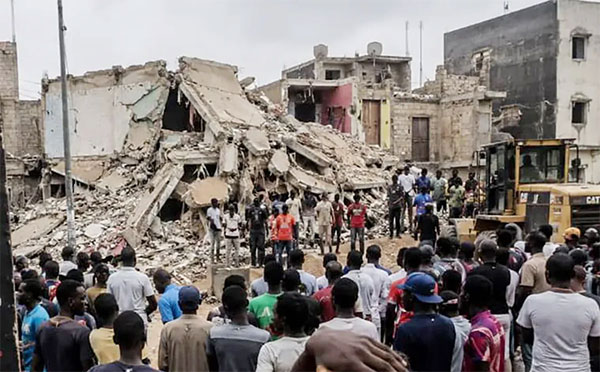
The tragedy that occurred on Tuesday 27 October in the Sud Stade district of Thiès has reignited the debate on compliance with building standards. While the provisional toll stands at one dead and two injured, the Ministry of Urban Planning has revealed that the building had disregarded its initial permit, which was limited to R+3 (ground plus three floors), by erecting two illegal storeys, despite an order to halt the works.
By Cheikh CAMARA. – The Railway City is in shock after the tragedy in the Sud Stade district, near the La Brioche Dorée shop. On Tuesday 27 October 2026, a building under construction suddenly collapsed, causing alarm among the local population and bringing back to the fore the pressing question of the safety of buildings under construction across the country.
A heavy human toll and tense searches
As soon as the alarm was raised, the emergency services and firefighters were deployed to the scene to try to extract any victims trapped under tonnes of concrete and steel. The first official toll released by the administrative authorities reported three people buried under the rubble. Thanks to the speed of the rescue operations, two of them were rescued alive and rushed to a regional health facility to receive appropriate care.
Unfortunately, the third person was not so lucky: their lifeless body was pulled from the ruins.
Two storeys too many: a blatant violation exposed
Beyond the grief, the time has come to establish administrative and technical responsibilities. In an official statement issued shortly after the accident, the Ministry of Urban Planning, Local Authorities and Territorial Development, headed by Bala Moussa Fofana, provided precise clarification on the legal status of the building.
A thorough examination of the administrative file shows that the developer held only a permit for raising the building strictly limited to R+3 (ground floor plus three storeys). On the ground, however, the work had far exceeded the legal framework. During an inspection carried out on 9 June 2026, the Thiès Regional Urban Planning Division saw for itself that the works had continued up to R+5. Two additional storeys had thus been built in total illegality, without any technical or administrative approval. Following this established violation, an order for the immediate halt of the works had been formally marked on the structure of the building.
Technical assessment and establishing responsibility
While the breach of the planning permits already appears to be a central factor, the ministry nevertheless points out that the exact mechanical causes of the collapse have yet to be established scientifically. An in-depth technical assessment will be commissioned very shortly. It will cover in particular an analysis of the overall structure of the building, the load-bearing capacity of the original foundations and load-bearing elements in the face of the extra weight caused by the added storeys, the quality of the construction materials used and the conditions under which the work was carried out.
In close collaboration with the territorial administrative authority, the local council and the relevant technical services, the ministry has undertaken to secure the perimeter of the disaster site immediately to prevent any further accident. The authorities intend to carry out all the necessary checks so that all responsibilities, whether civil or criminal, are established by the competent bodies.
Towards tighter controls on building sites
To prevent similar tragedies in future, the supervising ministry is promising a drastic stepping-up of inspections of building sites under way, as well as of existing buildings showing visible signs of deterioration or structural instability.
The ministry firmly reminds all those involved in the built environment that all construction must be carried out strictly in accordance with the permits issued, the duly approved plans and the technical standards in force. Any project to raise a building or add storeys remains strictly subject to prior authorisation, issued only after verification of the mechanical strength of the host building.
Project owners, property developers, architects, design offices and construction and public works companies are formally ordered to comply with these legal requirements, failing which they will be liable to the severe penalties provided for by Senegalese regulations. Finally, the ministry has issued an urgent appeal to the public, inviting them to show civic vigilance by systematically reporting to the Urban Planning services or local authorities any suspicious building site or building posing a risk to public safety.
cheikh.camara@lequotidien.sn
Comments (0)
Be the first to comment.
Sign in to comment